In 1988 I travelled to southern California to study Jin Shin Do® Bodymind Acupressure™ with Iona Teeguarden. While there I helped to type the JSD Foundation newsletter and was invited to reply to a letter from a reader enquiring about Iona’s non-standard location of Liver 14. In those early days of my studies and with internet research a thing of the future, I was unable to respond. Here then, 35 years late, is my reply.

Qimen ~ Cycle Gate/Gate of Hope ~ Liver 14
The last point of the Liver meridian is a significant one. Here the Qi completes the cycle of the 12 meridians before flowing through to Lung 1 whence it started. It is a place where Qi can become blocked, causing congestion in the chest, and reflecting stagnation in the Liver organ, or pent-up feelings of frustration and anger. Its location, however, is not straightforward, and I have encountered three different locations that derive from different traditions. What follows is something of a detective story as I try to unravel the historical origins of each location. Please forgive me, reader, for my attention to such arcane detail. It seems my Metal Element is showing through.
Standard Qimen
The standard location in Traditional Chinese Medicine (TCM) of Qimen – Cycle Gate – Liver 14 is in the chest, in the 6th intercostal space and 4 cun lateral to the midline, on what is known as the mammillary line (in line with the nipple). This is the location that is most widely used and became the standard with the codification of acupuncture in China in the 1950s. Here is the location from Peter Deadman’s A Manual of Acupuncture.

Lower Qimen
A minority of practitioners locate Liver 14 much lower, on the border of the ribcage, also on the mammillary line. This location became standard for students of JR Worsley’s Five Element Acupuncture method which became especially widespread in England and the USA. Here is the location from Worsley’s Traditional Chinese Acupuncture Vol 1 which is known affectionately in his community as “the big red book”.

This alternative location has become widely enough known that it is acknowledged by Deadman, and by Jarmey in his Practical Guide to Acupoints, as “Lower Qimen”:

As a keen student of history and of lineage, I had always wondered about the origin of Worsley’s deviation. I found a possible answer earlier this year when I obtained a copy of the book Chinese Acupuncture by the Taiwanese acupuncturist Dr Wu Wei-Ping. Published in 1962, his work was translated into French by Jacques Lavier which was in turn translated into English by Philip Chancellor. It is known that Worsley studied with Wu Wei-Ping in Taiwan. Peter Eckman in his book, In the Footsteps of the Yellow Emperor, shows photos of Worsley with Wu in 1966. Wu’s location is clearly at “Lower Qimen”:

Where did Wu get his alternative location? One possible source is Japan which ruled Taiwan from 1895-1945 and had strong cultural influences over the island. In my searches I discovered at least one Japanese luminary who made use of the lower location. That is Dr Yoshio Manaka (1911-89).
Eckman describes Manaka as having good relationships with many of the Japanese schools of acupuncture but never became identified with any one. He also had numerous contacts among the French and German schools which were being established and he made several teaching trips to Europe. It’s possible that Worsley had direct contact with Manaka. Here is the location from Manaka’s book, Chasing the Dragon’s Tail. (Mislabelled as LV 4)
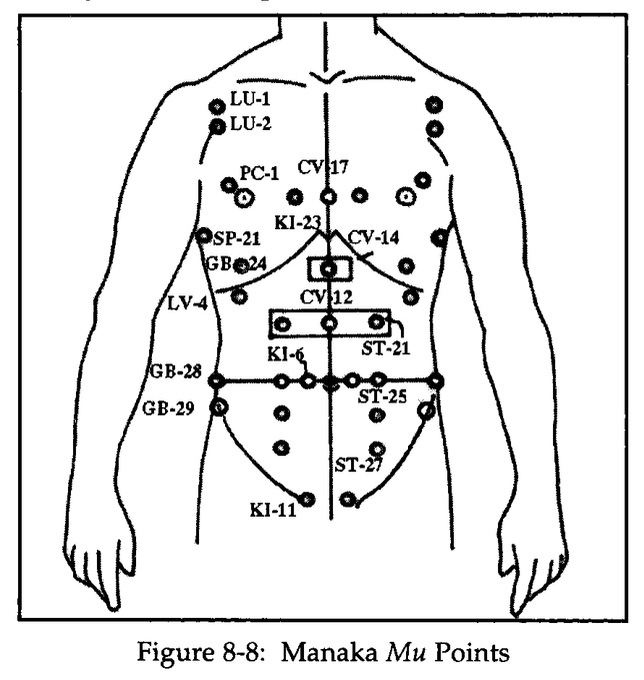
Acupuncturists of the Worsley lineage consider Lower Qimen to have greater psycho-emotional and spirit associations that are not ascribed to the standard location by TCM practitioners. Indeed, Worsley gave the name Gate of Hope to this lower point rather than the usual translation Cycle Gate. This suggests its power to support a person to face the future with clarity and enthusiasm, alleviating depression caused by stagnation of Liver Qi.
Several years ago, I received an email from Peter Borten, an acupuncturist in Portland, Oregon, in response to my original blog on this point. His comments made an impact on my view of of the two different locations. Peter said,
“As I went first to a TCM school and then a Five Element school under J.R. Worsley, I see the TCM and Five Element locations of this point as having distinctly different energetics. When I’m needling this point for its Five Element “spirit of the point” properties, or to clear an entry-exit block, I always go with the Five Element location at the bottom of the ribcage.”
I now follow this advice in clinic, using Lower Qimen as a “spirit” point and when I detect an entry-exit block between Liver 14 and Lung 1.
One other thing to note before we leave Gate of Hope, is that Worsley-trained acupuncturists often needle Liver 13 (Chapter Gate) and Liver 14 (Gate of Hope) together: a new chapter of life heralds the hope of moving forward.
Inner Qimen
Now we come to the third and most obscure of the three locations, the one that was subject of the letter to the Jin Shin Do Foundation. We might call this “Inner Qimen”. Iona Teeguarden located Liver 14 at the bottom of the ribcage but more medially to the Worsley location. (Number 5 in the JSD system.) In her 1978 book Acupressure Way of Health, she located it on the ribcage at the junction of the ninth rib cartilage to the eighth rib, in a little indentation inside the nipple line. This places it about 1 cun medial and superior to the Lower Qimen. In her later book Joy of Feeling, Teeguarden calls this point Gate of Hope, so clearly there was a Worsley connection.

I used this location for many years until I moved to the standard location in the 6th intercostal space. However, I do return to it from time to time. I find it very helpful in releasing points in the neck. When Small Intestine 16 is not releasing, I will hold it in combination with the opposite “Inner Qimen” and find that usually opens the neck wonderfully.
According to a biography on the Jin Shin Do Foundation website, Iona learned Jin Shin Jytsu with Mary Burmeister who was a student of the founder of that method, Jiro Murai. Iona travelled to Japan in 1976 and studied with Dr Haruki Kato, also a student of Jiro Murai. She states that “some of the JSJ points were in different locations than I had learned from Mary.” One of Burmeister’s “safety energy locks” (SEL 14) was in the location of Lower Qimen; I infer that this was one of those points which varied and that Inner Qimen is from Kato. The following illustration is from Alice Burmeister’s book The Touch of Healing.

While researching for this blog. I stumbled upon a graphic produced by Shohaku Honma (1904-1962) which shows Liver 14 on the ribcage but clearly more medial to Lower Qimen. I have not seen this location anywhere else, but here it is being used by a famous Japanese acupuncturist with whom Worsley studied. What could be the connection between Teeguarden and Honma? Could it be Kato? As part of his studies, Kato became a licensed acupuncturist so he could have professional and legal standing. Perhaps here is a connection to Honma.

Clinical Implications
Well, dear reader, if you are still with me after this deep dive into history, congratulations! I salute your perseverance.
Let me finish by summarising the clinical implications of these three different locations of Qimen Liver 14, for it is the clinical outcomes that are of greatest importance.
Standard Qimen is the mu point of Liver and so treats acute conditions that relate to the Liver organ. It also treats local congestion in the chest and ribcage. It can have an effect on the emotion of anger which, when out of balance, is stored in the Liver.
Lower Qimen is the Worsley location. It is also a mu point and treats at the physical level. But more significantly it treats psycho-emotional disharmony in the Wood Element and at the level of spirit. It helps lift depression, enabling a person to see clearly the way forward and make plans with hope for the future. It also is useful when there is an entry-exit block between Liver and Lung.
Inner Qimen is a useful alternative for both physical and psycho-emotional issues, for suppressed anger and frustration, for releasing the diaphragm and the associated neck segment.
As in all cases, the point is not on the chart, it is where you feel the Qi.


