Tag Archives: Entry exit points

Thumbs Up for Autumn

In my street in the Adelaide Hills the deciduous trees have almost finished shedding their leaves, forming glorious, multi-coloured piles to line the footpaths. Autumn is drawing to a close. Jut time to squeeze in a Metal blog, a treatment for congestion in the distal end of the Lung channel.

A fairly common complaint in clinic is pain in the thumb that arises from overuse. This may be, for example, a massage therapist who is doing a lot of deep tissue work, a rock climber who is using a lot of hand strength, a gardener who’s been doing a lot of pruning, or a sheep farmer who has been crutching several hundred sheep. Sometimes the pain arises spontaneously and may be related to emotional issues. And then there is arthritis, an inflammation of the joints which typically affects the thumbs first.

The meridian that passes through the thumb is that of the Lung. It begins at the outside of the upper chest, passes down the arm near the biceps muscle, along the inside of the radius bone, through the pad of the thumb, and finishes at the nail bed of the thumb. The exit point of this channel is Lung 7, quite some distance from the end. (See below for point locations and illustrations.) The Qi flows from there into the entry point of its partner meridian at Large Intestine 4 in the webbing of the hand. One might expect these exit and entry points to be the first and last points of a meridian, but this is not always so. In this case, neither the exit point of Lung nor the entry point of Large Intestine is the end point. (The end points are Lung 11 and Large Intestine 1 respectively.)

The only authority I can find who offers any discussion of this is Felix Mann in his 1962 book “Acupuncture: the ancient Chinese art of healing”. He implies that, where the points are not the last or first, there is a secondary connection between the last and first points. Nonetheless, I have noted a tendency in these cases for a stagnation to occur in the sections of the meridian distal to the exit points.

Let’s look at these points on the Lung channel that are distal to the exit point, namely Lung 8, 9, 10 and 11, for these are the points I’m interested in treating when there is pain in the thumb.

The first thing I look for is a block between Lung 7 and Large Intestine 4 which are the true exit and entry points between these Metal meridians. Hold the two points together for about 3 minutes or until there is a feeling of flow and balance between the two points. Then continue to hold Lung 7 with one hand and with the other hand, hold in succession Lung 9, Lung 10 and Lung 11 , feeling for a sense of blockage in the points. (I’ve excluded Lung 8 here because it is so close to Lung 7.)  Often Lung 10 will be the most tight,  sore and blocked.

A further technique that can be employed is to add a gentle stretch to the thumb. This is not acupressure but works at the level of the fascia. * Gently grasp the thumb and apply a slight traction while you hold each point in succession from Lung 7 to Lung 10. Maintain these holds for up to 3 minutes each or until you feel the Qi move and the fascia begin to soften. It can feel like something opening, flowing, spreading or rushing under your fingers.

Finally, check the “secondary” exit and entry points that Mann suggested by holding Lung 11 and Large Intestine 1 together.

For those clients who continue to place strain on the thumbs, and probably for arthritis sufferers too, the effects of this technique will likely be short term but should offer relief. And for those for whom the issue is acute, there is a good chance of resolving the case.

It may also be worthwhile to investigate at the emotional level. Is the person carrying long-term grief? Is there difficulty letting go of a person, object, idea or belief that is no longer serving? If so, then working with other Lung-related points such as Lung 1, Bladder 13 and Bladder 42 can help. It’s interesting to note how the notion of holding on with the mind is reflected in the clenching of the hand, and how the thumb places the cap on the clenching.

The falling autumn energy in Nature demonstrates that letting go is a natural phase of all existence. It may be a good time to take her hint and shed some of the things  that you’ve been hanging on to.

* A review of the recent research into the connection between meridians and the fascial network can be seen here in my article How Does Acupressure Work? Exploring the connection between meridians and fascia (PDF)
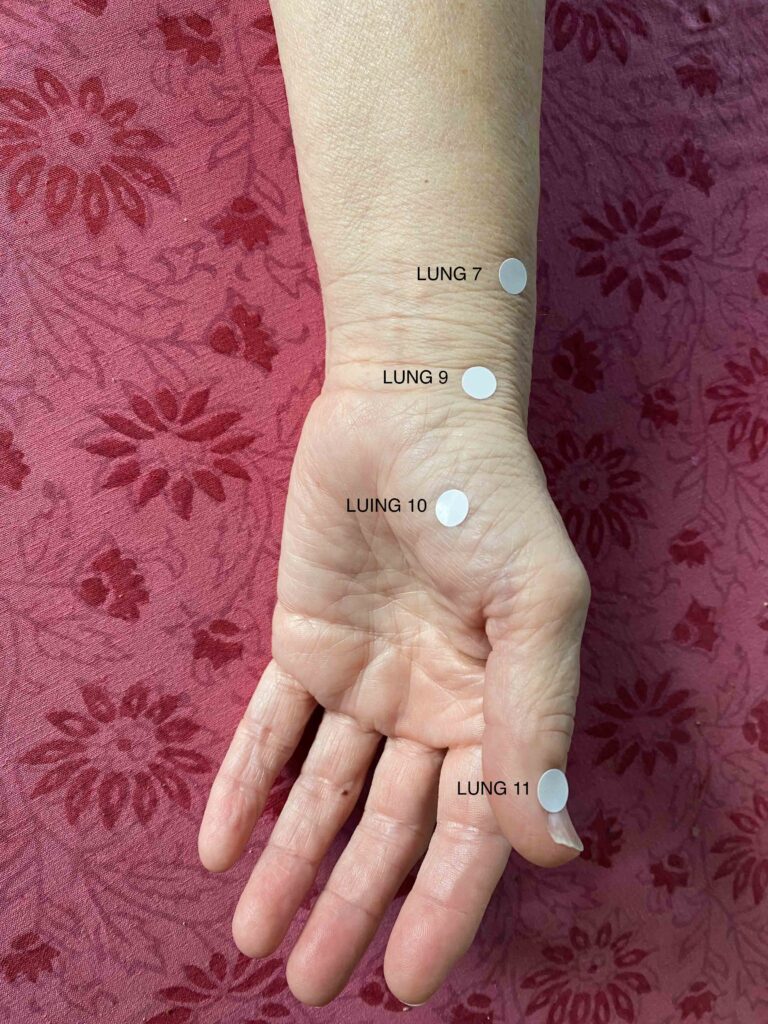
Lung 7 is in a notch on the radius bone, 1.5 cun (thumb widths) above the wrist crease
Lung 9 is at the wrist crease in a hollow between the radius and a tendon
Lung 10 is in the pad of the thumb, half way along the metacarpal bone
Lung 11 is at the corner of the nail bed of the thumb

Large Intestine 1 is at the corner of the nail bed of the index finger
Large Intestine 4 is in the webbing, halfway along the metacarpal
Myofascial stretch while holding Lung 10

Summer Solstice

For our northern hemisphere readers, here’s a link to the previous Winter Solstice article to make you feel hemispherically synched.

Today is the summer solstice in the southern hemisphere, the middle of summer and the point at which the year expands to its limit. It’s as if the Earth has taken a long, deep breath in and can expand no more. After today, the yin half of the year begins, and the long slow exhalation propels us towards the winter solstice in 6 months time.

Correspondingly expansive movements of the body include spreading the arms wide and opening the heart centre to give of ourselves and to receive the world. The Heart is the primary organ of the Fire Element whose summer season this is. The Heart, Emperor of our personal kingdom, beats ceaselessly for our whole life, maintaining the steady drumbeat of our personal world.

Another expansive movement is to raise the arms up and out. You often see this movement at festivals and sporting events where whole stadia of people signal their excitement by raising their arms to the heavens and shouting with joy. Showing their armpits to the world with abandon.

UTMOST SOURCE

Speaking of armpits, I want to spend some time here introducing an important acupoint which lies deep in the armpit, an area rarely exposed but kept protected by our arms at the sides. In the modern world most of us don’t raise our arms up high very often unless it’s in the shower or to reach for something on a high shelf. We rarely climb trees or hang from branches as did our primate ancestors. This point is rather secret and somewhat intimate.

The point is Jiquan Heart 1, known variously as Summit Spring, Utmost Spring and Supreme Spring. But I like Worsley’s translation of Utmost Source, because it echoes the nature of the Heart and its resident spirit the shen. Shen is our connection to utmost heaven, the heavenly light that resides within the heart of each one of us.

The Heart Qi arises from the organ of the Heart, passes through the Lung, and emerges in the armpit at Jiquan like a spring bubbling out of the ground. The Qi then travels along the inside of the arm, heading for the little finger as the Heart channel is mapped out through its 9 points.

When the Heart and its channel are open and balanced, there is connection to our True Nature which doesn’t have to do anything. The Heart’s calling is not to do but to be. In the metaphor of the Emperor, his task is simply to sit on the throne and hold the space from a place of stillness. This is a great teaching for us to emulate in our often turbulent times. Holding space, holding stillness, holding presence. Just being.

Back to the armpits, Heart 1 is a common place for Qi to become blocked. In the Wei Qi cycle of the 12 meridians, the previous point is Dabao, Spleen 21 Great Enveloping. Where a channel of one Element moves into a channel of another Element, there is a greater tendency for Qi to become blocked. These are known as Entry-Exit blocks (though the pedant in me would argue for Exit-Entry blocks). Here, where the Earth energy of Spleen moves to the Fire energy of Heart, we find the most common of the Entry-Exit blocks. These blocks are usually diagnosed on the pulse. In this case an excess Spleen pulse and a deficient Heart pulse would indicate a block. But physical and psycho-emotional symptoms can also point to the possibility of a block.

At the physical level, possible indications of this block include pain or constriction in the lateral ribcage or in the armpit, difficulty raising the shoulder, palpitations and shortness of breath. Surgery or injury to the area can also be a cause. Constriction in the flow of lymph to the lymph nodes in the armpit is another. Recently I’ve had a cluster of cases of severe lymphoedema in the legs, and I’ve found that in most of these cases there was a Spleen-Heart block.

At the psycho-emotional level, this block may stem from difficulty in allowing the nourishment of the Earth Element into the Heart. There may be sadness, anxiety, mental restlessness or disconnection from the joy of life.  It may indicate challenges with intimacy or betrayal that have closed the emotional heart. Eating disorders which stem from deep dissatisfaction with one’s life might also be indicators of this block.

If you suspect there is a block in the Qi flow at Heart 1, hold the point with sustained moderate pressure for a few minutes until you feel the subtle Qi flow and that the point is open. Also hold Spleen 21 in the side of the ribcage until you feel the open flow of the subtle energy there. Treat both sides

In Qi Gong practice and in some meditation practices, practitioners are advised to stand or sit with enough space in the armpit to ‘hold an egg’. This allows free flow of Qi through the armpit and along the Heart meridian of the arm. We can take note of this and avoid long periods of holding the arms tightly to the sides.

Jiquan is a spirit point that connects our consciousness to the universal consciousness; it aligns our personal heart with the heart of the universe; and it promotes emotional warmth and connection to others through the Heart. In this season of celebration and family gatherings, it’s good to keep our hearts open.