Summit Walk Early Winter

Friday 29th May 2026
Late Early winter
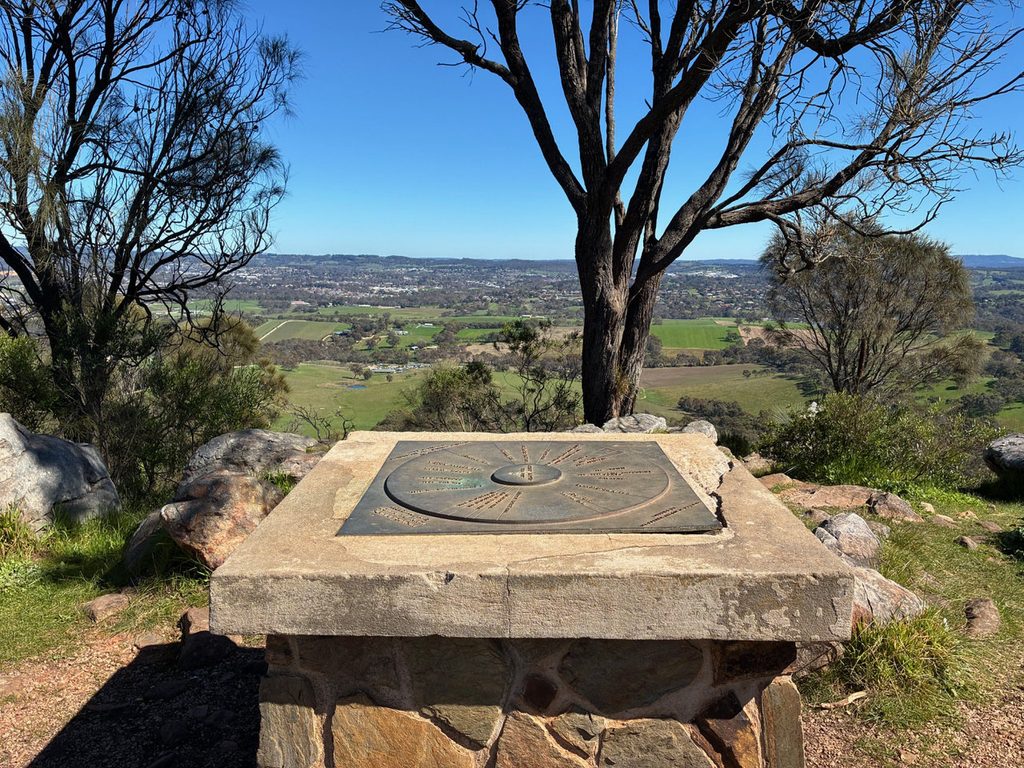
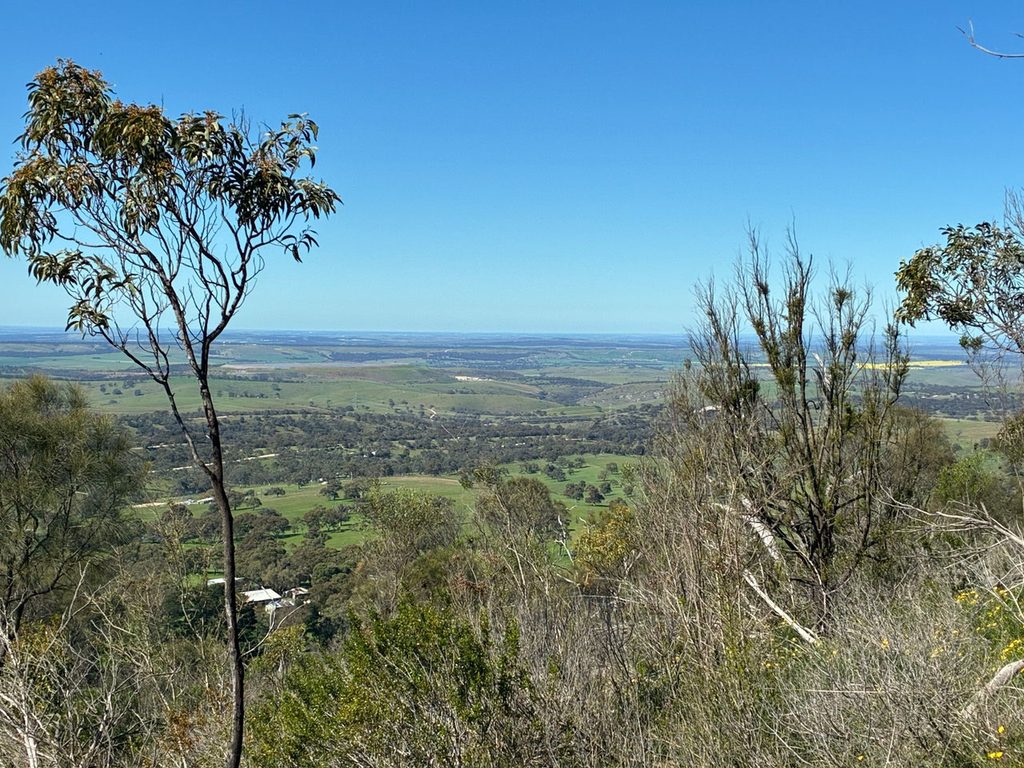
Mount Barker Summit – Womma Mu Kurta

I arrive mid-morning to a grey summit under a sinking sky. A weak sun shows its outline behind layered clouds. In the car park, a group of elderly volunteers sets up for a shift of eradicating invasive species. Otherwise, I have the mountain to myself.

It is years since I’ve been here. I used to visit several times a year, delighting in the seasonal changes, charting the pulsing of the year. Out and in. Up and down. Hot and cold. Yang and Yin. Now I have made a pact to visit at least once every season over the next year and to make a written and photographic record.

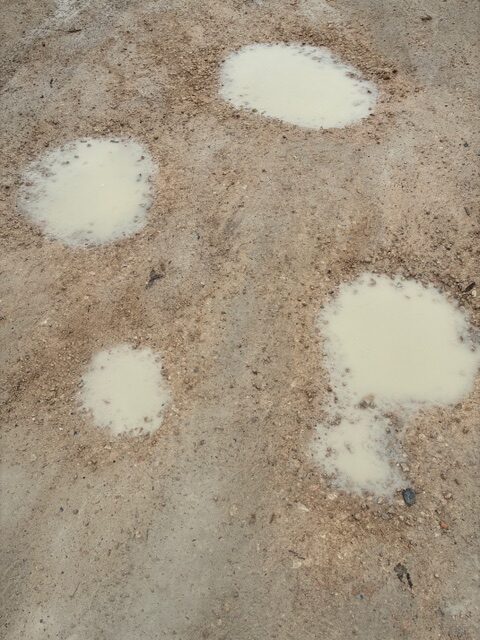
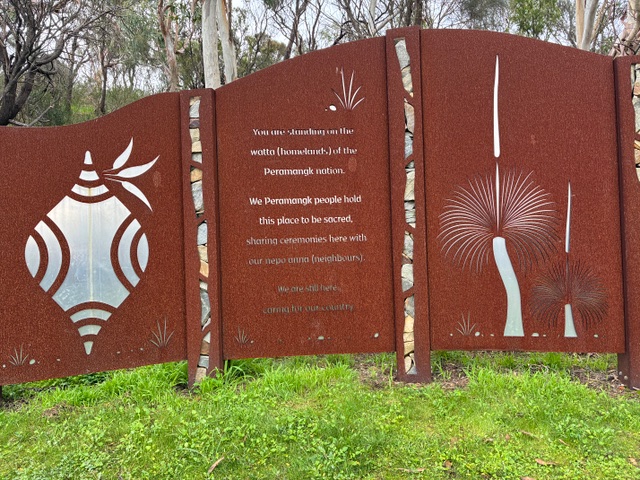
There have been changes to the signage around the carpark. Two beautiful installations of rock and metal welcome me to country of the Peramangk people. I used to feel something of an intruder up here, but now my heart is touched and I feel welcome to visit this sacred land. To reach the sculptures I step over puddles left by recent rain. Like meaningful configurations of stars, one group jumps out as a representation of the Five Element cycle. This too feels like Nature’s welcome for my Elemental project.

Five Element Puddle Cycle

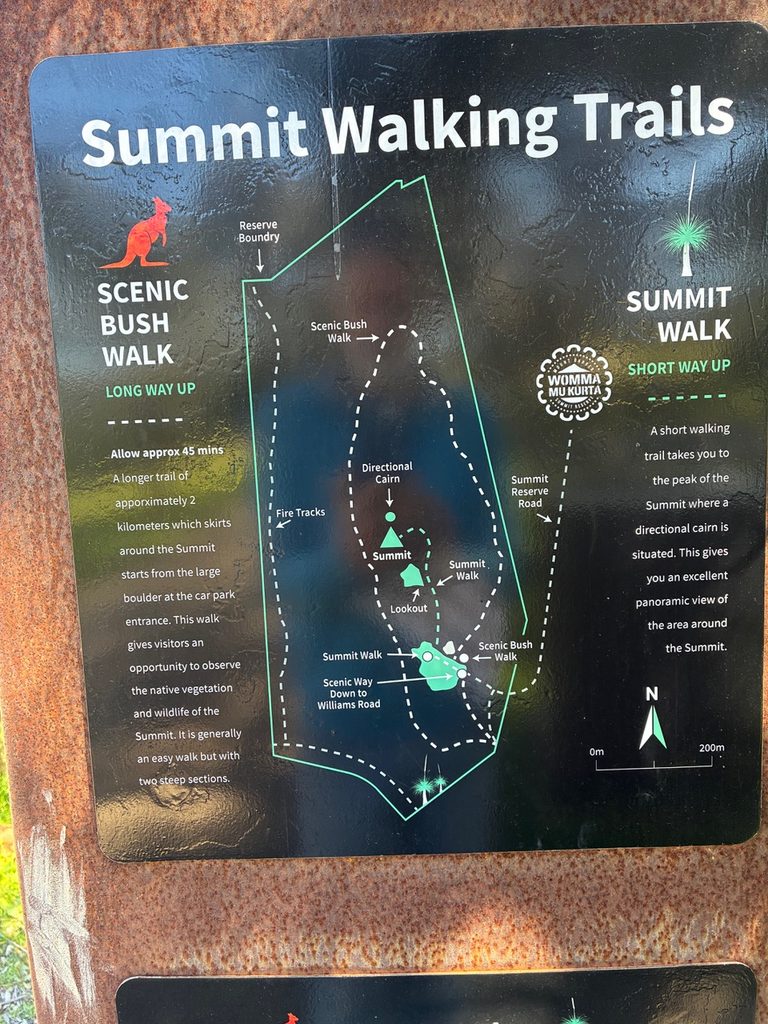
There is a short walk to the trig point on the summit, but today I choose the 2-kilometre loop that runs either side of the north-south ridge. On a map, the loop has the look of a stone axe which feels appropriate to the ancient land I am traversing.

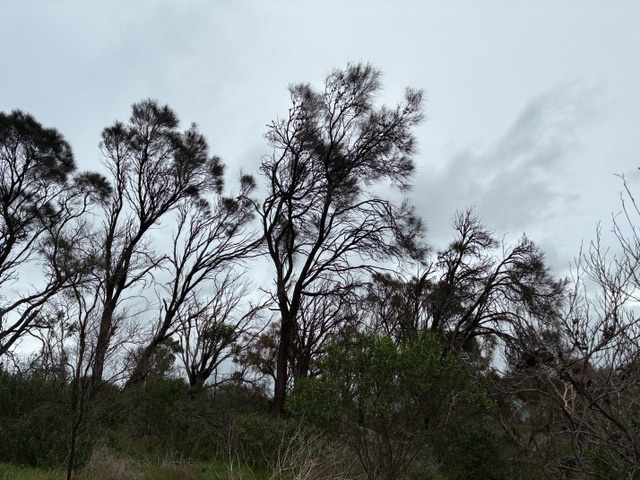
In this early winter, the temperatures are cool but not too cold. The path is muddy, the landscape damp from early rains. A few mushrooms sprout by the path, something I’ve never noticed here before. I am alone, see no-one, and enjoy the solitary commune with nature. I am in my feet as I pick across the rocky outcrops in the path. When I look up, it is to gum trees windbent across a greyscape. I smile inside as the land seeps upwards from my boots, spreading through me like a blotter soaking ink.

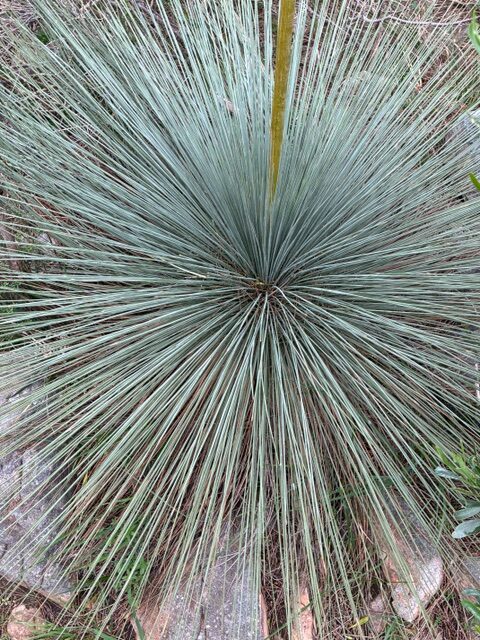
I have been sheltered from the wind thus far, but at the northern end of the loop, it gusts from the west and bites cold through my jacket. I welcome the discomfort as part of plumbing the Water Element. Here my eye is caught by a silver-green shimmer of movement on the wind. It is a young grass tree, xanthorrhoea, its multitude of slender spikes radiating light. In the greyness of the day it stands out in a way I haven’t  noticed on brighter days. The winter backdrop brings these plants to the fore, like the bass in a band stepping forward for its solo.

Grass Tree – Xanthorrhoea

On the west side, the path drops down through more dense shrubs and trees, and the light fades to gloom in places. I must stoop and bend to avoid drooping branches. It is very quiet here, sheltered from the noise of the south-eastern freeway which sprays the eastern side of the ridge with its endless hiss. The silence deepens my connection with the land and with the Water Element that I have come to seek.

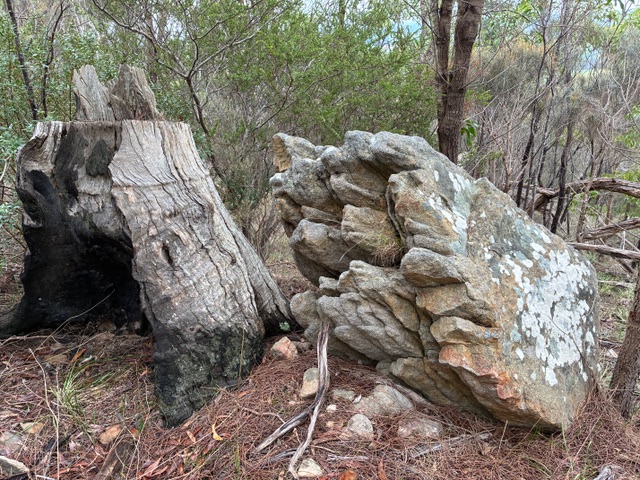
My mind is caught by a curious sight which I stop to photograph. On the downslope, an ancient tree stump, smoothed with age and blackened by fire, nestles with a rock formation that echoes its form. Wood becomes stone; stone, wood. I think of the Wood-Metal axis of the Five Element Cycle which represents the seesaw of the ethereal and the corporeal. These Elements surround the Water Element which is the focus of my day, but remind me of the interconnectedness of all the Elements.

Wood Stone Nature Sculpture

The journey on this side of the ridge seems longer, for I have slowed down to match the yin nature of this part of the path. But finally, it takes me upwards on a slippery, stony slope to a broad path that returns to the car park.

I return to the installations of country and once again am touched by their welcome. I will return here to continue to chart the passage of the seasons and the Elements. Perhaps again in winter, certainly in spring.

I invite you to find your own special place in nature, and visit it in each season over the next year. You may find some unexpected discoveries, not only in nature, but in yourself.

Welcome

AUTUMN FOOD

I love a good curry. Give me a masala dosa or a vegetarian thali, or an aloo gobi with a Goan fish curry, and we’ll be friends for life. My travels in India are among my fondest culinary memories. Eating food with fingers from palm leaves in vast halls, samosas with chai on railway platforms, long spicy fish lunches at beach huts in Kerala. Ah, but I digress. These are samples of the pungent taste that is the resonance of the Metal Element, tastes that are concentrated, distilled and bursting with an aromatic flavour. Herbs such as rosemary, thyme, cinnamon, nutmeg, cardamon, garlic and ginger are also in the realm of the pungent.

The season of Autumn is the best time to be adding warming, spicy, aromatic foods to our diet, for this pungent flavour supports the Metal Element and its organs of Lung and Large Intestine.

In the early autumn as the temperature and humidity drop, one should transition from the cooling foods of summer and the damp-clearing foods of late summer to neutral and yin-nourishing foods. As the autumn deepens and the weather gets colder, add warming spices and cruciferous vegetables to support the Metal Element. As the season dries, and especially in dry climates, add lung-moistening foods such as pears, pawpaw and honey.

Vegetables that support the Metal Element include radish, cauliflower, shitake mushrooms, sweet potato, parsnip, spinach, Brussels sprouts, pumpkin, leek, broccoli, fennel, onion, spring onions and chives.

Among the fruits, choose apple, tangerine, pear, golden kiwi, guava, persimmon, peach and fig.

Other foods that are supportive of the Metal Element are black sesame seeds, sesame oil, oats, red rice and black beans. For protein: tahini, silken tofu, duck, river fish and crab.

Pungent foods are said to move or disperse Qi, loosen stagnation and strengthen the Lung. This is especially useful when there is an invasion of pathogenic factors such as Wind or Cold. The pungent foods help to expel the invasion via the skin, often by sweating, and releasing to the exterior. The flavour can be used to protect against colds and flu, boosting immunity by stimulating defensive Qi. If, however, the Lung Qi is weak, then pungent food should be consumed in moderation as too much will scatter the Qi.

The Nei Jing tells us that “the pungent taste can ventilate the lungs and open the pores” but that “excessive consumption of the pungent taste may injure the pores and skin.” (Su Wen 5). Not only does too much pungent food injure the organs and tissues of its Metal Element, but it also has a flow-on effect on the Wood Element. “Overindulgence in pungent food can cause spasms, tremors, and poor nails.” (Su Wen 10) This is an example of an excess of the flavour of one Element acting on the grandson Element. In this case, Metal is invading the Wood.

Zoey Xinyi Gong in her Five Elements Cookbook warns that too much hot sauce, chilli etc can bring heat to the lungs (Metal) and liver (Wood), causing skin issues, hair loss, anger, restlessness and insomnia. It can also cause dryness in the Large Intestine leading to constipation. If you are prone to reaching for the 5-star hot sauce, you may therefore want to temper your usage. (Note to self!)

This blog post completes our year-long exploration of the foods of the Five Elements. Normally at this time I am already thinking of a new theme for the coming year. But for the first time, nothing has arisen and I wonder why. My first blog was posted in February 2014, just as the Wood Horse Year came galloping in. Here we are 12 years later in the Year of the Fire Horse, a year that promises change at all levels, so I am reassessing my blogging. Perhaps I’ll take a break, or perhaps I will post when the inspiration arises, rather than setting myself a timetable of blogging on a theme in each season. If, dear reader, you have read this far, I am humbled by your interest. If there is something you’d like to suggest for a topic, or even just to say hello, feel free to email me. My contact details are on the website.

With warm wishes

John