
In my street in the Adelaide Hills the deciduous trees have almost finished shedding their leaves, forming glorious, multi-coloured piles to line the footpaths. Autumn is drawing to a close. Jut time to squeeze in a Metal blog, a treatment for congestion in the distal end of the Lung channel.
A fairly common complaint in clinic is pain in the thumb that arises from overuse. This may be, for example, a massage therapist who is doing a lot of deep tissue work, a rock climber who is using a lot of hand strength, a gardener who’s been doing a lot of pruning, or a sheep farmer who has been crutching several hundred sheep. Sometimes the pain arises spontaneously and may be related to emotional issues. And then there is arthritis, an inflammation of the joints which typically affects the thumbs first.
The meridian that passes through the thumb is that of the Lung. It begins at the outside of the upper chest, passes down the arm near the biceps muscle, along the inside of the radius bone, through the pad of the thumb, and finishes at the nail bed of the thumb. The exit point of this channel is Lung 7, quite some distance from the end. (See below for point locations and illustrations.) The Qi flows from there into the entry point of its partner meridian at Large Intestine 4 in the webbing of the hand. One might expect these exit and entry points to be the first and last points of a meridian, but this is not always so. In this case, neither the exit point of Lung nor the entry point of Large Intestine is the end point. (The end points are Lung 11 and Large Intestine 1 respectively.)
The only authority I can find who offers any discussion of this is Felix Mann in his 1962 book “Acupuncture: the ancient Chinese art of healing”. He implies that, where the points are not the last or first, there is a secondary connection between the last and first points. Nonetheless, I have noted a tendency in these cases for a stagnation to occur in the sections of the meridian distal to the exit points.
Let’s look at these points on the Lung channel that are distal to the exit point, namely Lung 8, 9, 10 and 11, for these are the points I’m interested in treating when there is pain in the thumb.
The first thing I look for is a block between Lung 7 and Large Intestine 4 which are the true exit and entry points between these Metal meridians. Hold the two points together for about 3 minutes or until there is a feeling of flow and balance between the two points. Then continue to hold Lung 7 with one hand and with the other hand, hold in succession Lung 9, Lung 10 and Lung 11 , feeling for a sense of blockage in the points. (I’ve excluded Lung 8 here because it is so close to Lung 7.) Often Lung 10 will be the most tight, sore and blocked.
A further technique that can be employed is to add a gentle stretch to the thumb. This is not acupressure but works at the level of the fascia. * Gently grasp the thumb and apply a slight traction while you hold each point in succession from Lung 7 to Lung 10. Maintain these holds for up to 3 minutes each or until you feel the Qi move and the fascia begin to soften. It can feel like something opening, flowing, spreading or rushing under your fingers.
Finally, check the “secondary” exit and entry points that Mann suggested by holding Lung 11 and Large Intestine 1 together.
For those clients who continue to place strain on the thumbs, and probably for arthritis sufferers too, the effects of this technique will likely be short term but should offer relief. And for those for whom the issue is acute, there is a good chance of resolving the case.
It may also be worthwhile to investigate at the emotional level. Is the person carrying long-term grief? Is there difficulty letting go of a person, object, idea or belief that is no longer serving? If so, then working with other Lung-related points such as Lung 1, Bladder 13 and Bladder 42 can help. It’s interesting to note how the notion of holding on with the mind is reflected in the clenching of the hand, and how the thumb places the cap on the clenching.
The falling autumn energy in Nature demonstrates that letting go is a natural phase of all existence. It may be a good time to take her hint and shed some of the things that you’ve been hanging on to.
* A review of the recent research into the connection between meridians and the fascial network can be seen here in my article How Does Acupressure Work? Exploring the connection between meridians and fascia (PDF)
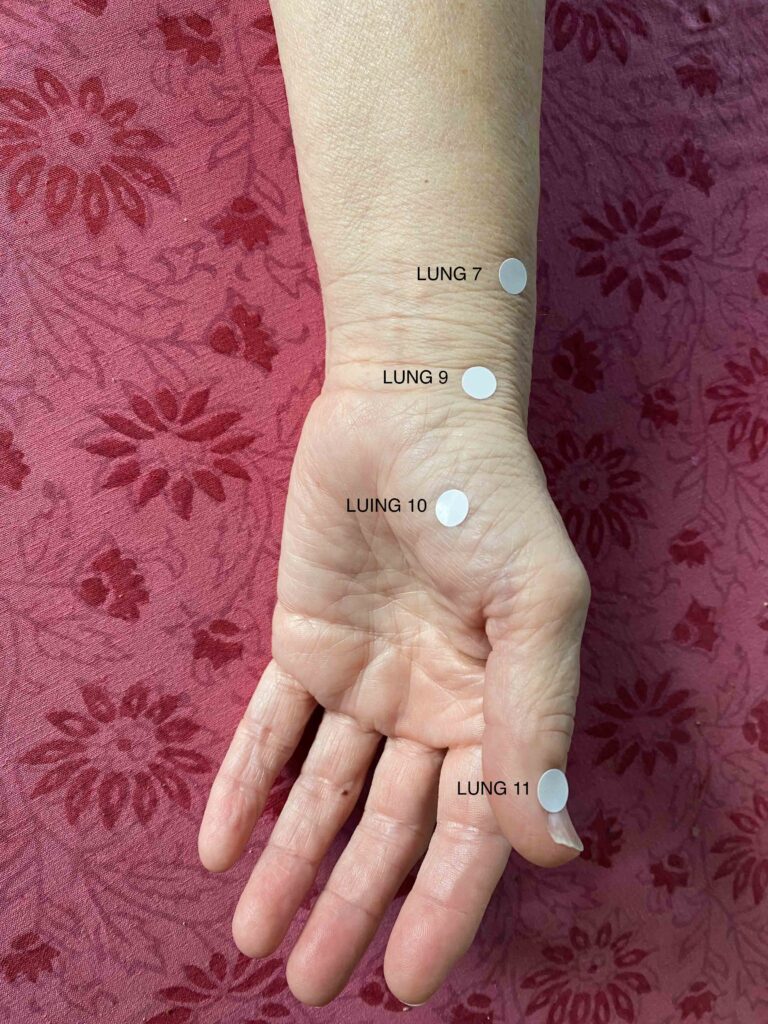
Lung 9 is at the wrist crease in a hollow between the radius and a tendon
Lung 10 is in the pad of the thumb, half way along the metacarpal bone
Lung 11 is at the corner of the nail bed of the thumb

Large Intestine 4 is in the webbing, halfway along the metacarpal

