Zhishi – Residence of the Will – Bladder 52
 Zhi is the spirit of the Water Element. The most usual meaning of zhi is will, though it has also been translated as ambition, purpose, determination, knowledge, mind and memory.[i] The will that is referenced here is not that of willpower and effort where there is a forceful pushing and drivenness to achieve goals. Rather, it works independently of a person’s volition, operating virtually below the level of consciousness, a force which moves a person towards his destiny without much conscious thought.[ii]
Kaptchuck describes it as ‘the will that can’t be willed’,[iii] meaning that it is the kind of will that allows the person to move forward without pushing the river. A person with strong Kidneys has a strong Kidney spirit, a drive to be alive; one with less Kidney strength may have a lack of drive but overcompensate by pushing himself.
Underpinning the zhi is the innate power of life itself, life that wants to live, strives to stay alive and survive. It manifests in the human drive to reproduce and thrive, something we have been remarkably successful at as a species.
The classics say that the kidneys house the zhi.[iv] Therefore anything that injures the kidneys will also injure the zhi. Fear that does not flow freely and release from the body will dwell in the kidneys. Chronic fearfulness, trauma, ongoing stress, penetrating cold, addictions, overwork and insufficient sleep will all contribute to draining the Kidney Qi and therefore the zhi. The saying ‘burning the candle at both ends’ is an apt expression of such depletion.
If the zhi is imbalanced, the result is a move to one of two extremes. At one extreme there is a collapse of will, resulting in a lack of drive and determination, listlessness and passivity, weakness, withdrawal and even despair. At the other extreme there is a restless, unrelenting activity that derives from strong ambition and hyper-determination. Put simply, there is either lack of drive or overdrive. Both are symptoms of zhi out of balance.
Other possible outcomes of zhi imbalance are forgetfulness and memory lapses, the overuse of stimulants to provide false fuel for activity, addictive patterns, insomnia, and nervous breakdown.
What does zhi look like when it is in perfect balance? Such a person moves forward without seeming to move, as if propelled by some invisible force. This kind of will is unobtrusive and tends to go unnoticed because it is so natural. It is well expressed in the Chinese concept of wu wei, the action of non-action. Wu wei refers to the cultivation of a state of being in which our actions are quite effortlessly in alignment with the ebb and flow of the elemental cycles of the natural world. ‘It is a kind of “going with the flow” that is characterized by great ease and awake-ness, in which, without even trying, we are able to respond perfectly to whatever situations arise.’[v]
Ultimately the highest form of will arises when the personal will is in alignment with the will of heaven. The will of heaven is stored in our essence (jing) and exists within as a blueprint for our highest development. We must align our personal will with this blueprint if we are to manifest our greater destiny. The situations that life presents us with provide the opportunities for understanding the need for this alignment to occur. The more balanced is our zhi, the more there will be inner knowing of how this alignment can arise.
There is another important balancing function of the zhi which can be seen in its Chinese character, part of which represents the Heart. The relationship between the zhi of the Kidney and the shen of the Heart is paramount in maintaining the Water/Fire balance which in turn is central to a person’s yin/yang balance.
This balanced connection allows the will of the Tao to be mediated by and expressed through the human heart. Harmonious action naturally arises as a willing surrender to the dynamic force of the Tao.
A point that deeply supports the zhi is Zhishi – Residence of the Will. It is the outer shu point of the Kidney and lies on the Bladder meridian. At the physical level it treats lumbar pain, incontinence, impotence and infertility. More deeply, as its name suggests, it strengthens the will, allowing access to courage, determination and perseverance. It supports a person who is experiencing chronic fear and anxiety which are detrimental to the kidneys and Kidney Qi. In such cases this point can assuage fear by engendering basic trust in the inherent supportiveness of true nature.

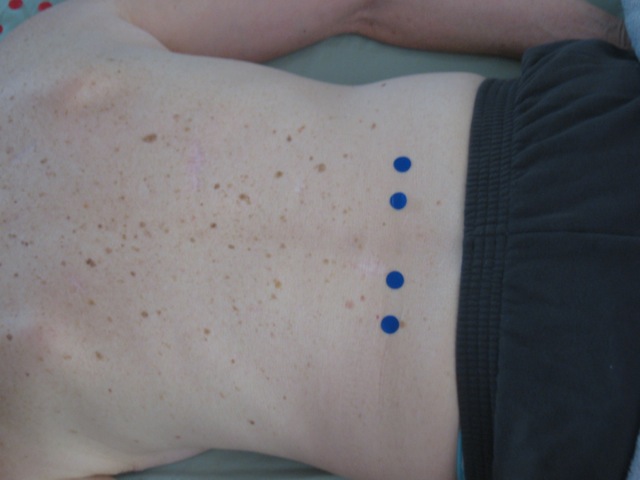
Location of Bladder 52
The point is in the low back at the level of the junction between vertebrae L2 and L3. This is roughly at the level of the navel. BL 52 is 3 cun (four fingers width) outside the spine. If you are working on someone else, have them lie face down and apply direct pressure with your thumbs. If you are working on yourself, lie on your back, make fists and place your knuckles into the points.
[i] Jarrett, L.S. (1998) Nourishing Destiny. Stockbridge MA:Spirit Path Press, p.57.
[ii] Hicks, A., Hicks, J. and Mole, P. (2004) Five Element Constitutional Acupuncture. Edinburgh: Churchill Livingstone, p.163.
[iii] Kaptchuk, T.J. (2000) The web that has no weaver, Chicago:Contemporary Books, p.62.
[iv] Maoshing, N. (trans) (1995) The Yellow Emperor’s Classic of Medicine. Boston: Shambala, p.96.
[v] Reninger, E. (2013) Wu wei the action of non-action, viewed 4 August 2013, <http://taoism.about.com>
This is an extract from ‘The Way of the Five Elements’ by John Kirkwood, to be published by Singing Dragon Press (an imprint of Jessica Kingsley Publishing) in November 2015.