Category Archives: Insomnia

A dyslexic guy walks into a bra

I’m a sucker for the snappy one liner and this one from George Carlin is a cracker. And this is just the tip of the funny bone. From puns to pies in the face, the parrot sketch to shaggy dog stories, from stand-up to the Groucho put-down, there are countless things that make us giggle, snicker, titter, chuckle and plain laugh out loud.

A good sense of humour is a great asset and support on the rocky road of life. Dating sites are full of people looking for a partner with a GSOH, presumably someone who will laugh at their jokes.

Laughter is not confined to the arena of joke-telling. Experiencing something unexpected can produce laughter. We can laugh spontaneously, feeling the joy of simply being alive. Laughter is the sound of joy bubbling out of the heart.

There are medical benefits too. Neurophysiology indicates that laughter is linked with the activation of the prefrontal cortex, the part of the brain that produces endorphins.  The old adage that laughter is the best medicine is being borne out by modern science.

There are many Fire points that can help us to access this lighter side of life. It is interesting to note that the first point of the Heart meridian lies tucked in the armpit, one of the classic places to be tickled. Another is Heart Protector 8 in the palm of the hand which we looked at earlier in the summer. I once had a series of acupuncture treatments  that included this point and every time it was needled I went into fits of giggling that had me and my acupuncturist in stitches.

Another important point that can help to access the laughter of the Heart and its many other qualities is the Heart Protector point Daling – Great Mound. When there is lack of joy or deep sadness, this point is helpful, for it calms the shen, spirit of the Heart. Indeed it is a good point for any emotional stress including anxiety, hysteria, grief, fear, fright and panic. When there is a feeling of vulnerability or insecurity, or a person is suffering relationship trauma, Daling is called for.

At the physical level, Great Mound regulates the Heart and relaxes the chest. It treats palpitations caused by fright, intercostal pain, eczema and other skin conditions arising from heat. It settles the stomach and intestines. Locally it can treat tendinitis and carpal tunnel syndrome.

The classic text, TheSpiritual Pivot, described the Heart Protector as the channel that pertains to the Heart, so Daling was originally indicated as the source point of the Heart rather than Shenmen, Heart 7 which we looked at earlier. Therefore this is a powerful portal to the Heart and its qualities of joy, contentment, radiance, equanimity, love and laughter.

By the way, did you hear the one about…


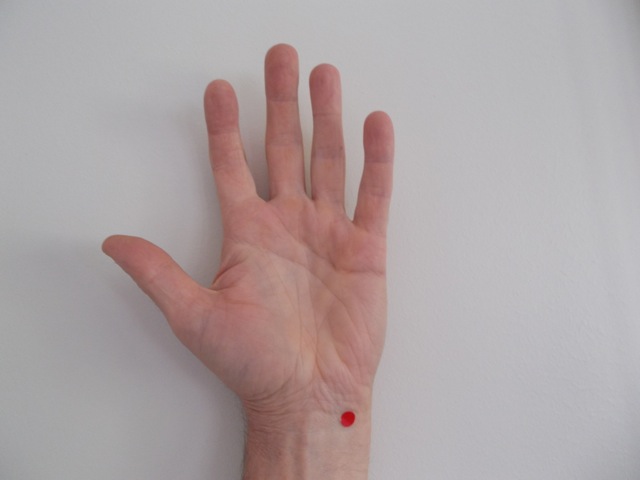
Location of Heart Protector 7

HP 7


The point lies in the very centre of the wrist crease on the front of the arm. It lies between the tendons of palmaris longus and flexor carpi radialis.

Mind Your Heart

HeartThe Chinese ancients saw the body’s organs as having functions far beyond their physiology. They saw the twelve organs as if they were twelve “officials” in a court, each with a ministerial role and a complex set of functions. They described the functions of these officials much more in terms of mind and spirit than physiology.

From this perspective, the Heart official is akin to an emperor who sits on the throne and holds the kingdom together simply by being himself. When the emperor is wise and moderate and all his ministers are taking care of business, then the kingdom functions harmoniously.

The Heart and its functioning are uniquely essential to life but are also very sensitive to disruption. Because of this, the other three Fire officials (Small Intestine, Pericardium and Triple Heater) act like an inner cabinet to the emperor. They take on the job of protecting and supporting the Heart, which they do in their various ways, monitoring communications from the Heart to the world and from the world back to the Heart.

Mind and Heart as One

The spirit of the Heart is shen. One modern authority, Giovanni Maciocia translates shen as mind; indeed the ancients saw no distinction between heart and mind, unlike the usual western view that mind is equivalent to brain function.

When the heart-mind is settled and protected, the shen resides there quietly. However, shen is easily disturbed by shock and trauma which can cause it to fly away like a flock of startled birds. When the shen leaves the Heart, the connection with spirit is lost and the person may feel apathetic, depressed and separated from themselves and the world. Others may see emptiness, vacancy and lifelessness in their eyes.

On the other hand, disturbance to the shen can result in hyper-excitement, a kind of false joy that appears ungrounded and unreal. Insomnia, restless activity, uncontrolled speech and even mania can be some of the manifestations of such disturbance to the Heart.

In choosing points to treat the Heart, we must be very careful to respect its delicate sensitivity. Some acupuncturists do not even use needles on the Heart meridian, preferring instead to treat it indirectly through Pericardium. Heart must be treated gently, treasured and honoured like an infant king.

One point that is safe to use is Shenmen – Spirit Gate. It is the gateway into the innermost chamber of the Heart. At the same time, it provides a gateway through which the Heart can express itself in the world. As the source point of the Heart meridian, it treats the organ directly, strengthening and stabilising it. The point will balances the Qi whether it is deficient or excess.

Shenmen soothes the mind and spirit, easing anxiety, sadness, depression and mania. It helps to mend a broken heart. It calms the physical heart, treating such conditions as pounding, palpitations and arrhythmia. Shenmen assists with memory and mental capacity; it helps with conditions of speech and the tongue including excessive speech; and it helps when there is insomnia and restless sleep, calming the heart and mind to allow for peaceful rest.

In the west we refer to the eyes as the windows of the soul. The perspective of Chinese medicine is that the eyes are windows into the heart-mind. The quality of the shen is seen in the eyes. When the shen is healthy, the eyes are alive with a “thereness” that makes intimate contact with the world while at the same time the person is in contact with himself. Spirit Gate helps us to move towards this way of being in the world.

Location of Heart 7

HT 7The point lies on the inner wrist crease, towards the ulnar (little finger) side and about one-fifth of the distance across the wrist. Feel for a hollow at the base of the pisiform bone. Apply gentle pressure for two to three minutes or until you feel the Qi moving. Hold the left side first, then the right. Tune into yourself as you do this. Treat it as a little meditation on your heart.