Category Archives: Metal Element

Thumbs Up for Autumn

In my street in the Adelaide Hills the deciduous trees have almost finished shedding their leaves, forming glorious, multi-coloured piles to line the footpaths. Autumn is drawing to a close. Jut time to squeeze in a Metal blog, a treatment for congestion in the distal end of the Lung channel.

A fairly common complaint in clinic is pain in the thumb that arises from overuse. This may be, for example, a massage therapist who is doing a lot of deep tissue work, a rock climber who is using a lot of hand strength, a gardener who’s been doing a lot of pruning, or a sheep farmer who has been crutching several hundred sheep. Sometimes the pain arises spontaneously and may be related to emotional issues. And then there is arthritis, an inflammation of the joints which typically affects the thumbs first.

The meridian that passes through the thumb is that of the Lung. It begins at the outside of the upper chest, passes down the arm near the biceps muscle, along the inside of the radius bone, through the pad of the thumb, and finishes at the nail bed of the thumb. The exit point of this channel is Lung 7, quite some distance from the end. (See below for point locations and illustrations.) The Qi flows from there into the entry point of its partner meridian at Large Intestine 4 in the webbing of the hand. One might expect these exit and entry points to be the first and last points of a meridian, but this is not always so. In this case, neither the exit point of Lung nor the entry point of Large Intestine is the end point. (The end points are Lung 11 and Large Intestine 1 respectively.)

The only authority I can find who offers any discussion of this is Felix Mann in his 1962 book “Acupuncture: the ancient Chinese art of healing”. He implies that, where the points are not the last or first, there is a secondary connection between the last and first points. Nonetheless, I have noted a tendency in these cases for a stagnation to occur in the sections of the meridian distal to the exit points.

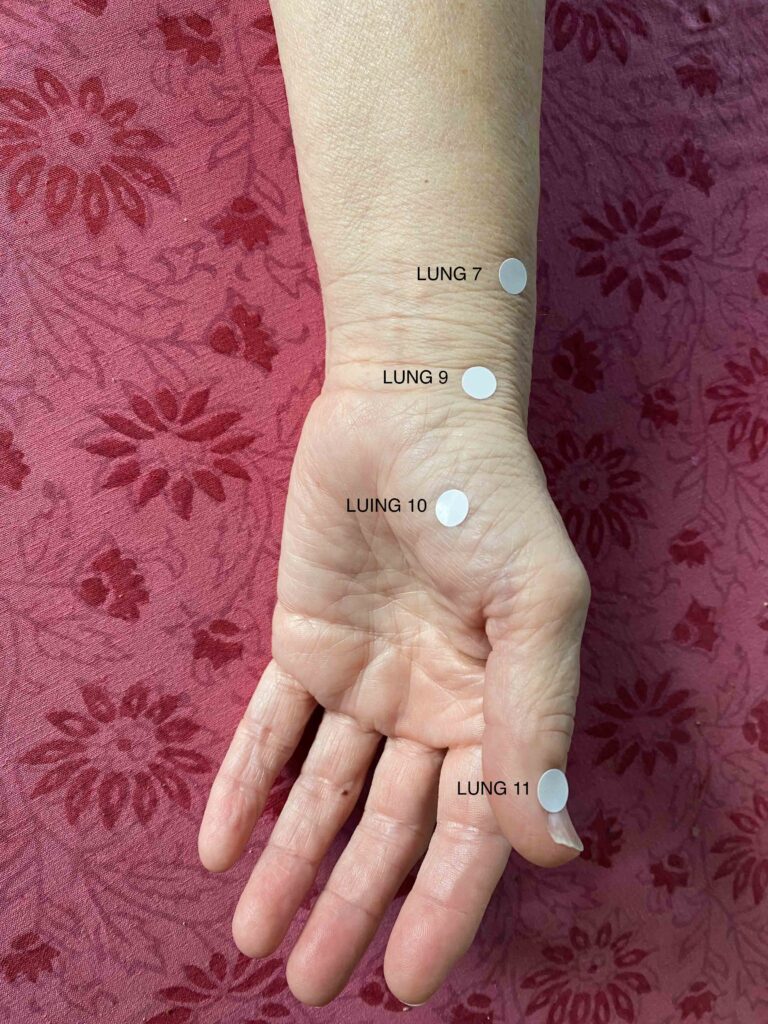
Let’s look at these points on the Lung channel that are distal to the exit point, namely Lung 8, 9, 10 and 11, for these are the points I’m interested in treating when there is pain in the thumb.

The first thing I look for is a block between Lung 7 and Large Intestine 4 which are the true exit and entry points between these Metal meridians. Hold the two points together for about 3 minutes or until there is a feeling of flow and balance between the two points. Then continue to hold Lung 7 with one hand and with the other hand, hold in succession Lung 9, Lung 10 and Lung 11 , feeling for a sense of blockage in the points. (I’ve excluded Lung 8 here because it is so close to Lung 7.)  Often Lung 10 will be the most tight,  sore and blocked.

A further technique that can be employed is to add a gentle stretch to the thumb. This is not acupressure but works at the level of the fascia. * Gently grasp the thumb and apply a slight traction while you hold each point in succession from Lung 7 to Lung 10. Maintain these holds for up to 3 minutes each or until you feel the Qi move and the fascia begin to soften. It can feel like something opening, flowing, spreading or rushing under your fingers.

Finally, check the “secondary” exit and entry points that Mann suggested by holding Lung 11 and Large Intestine 1 together.

For those clients who continue to place strain on the thumbs, and probably for arthritis sufferers too, the effects of this technique will likely be short term but should offer relief. And for those for whom the issue is acute, there is a good chance of resolving the case.

It may also be worthwhile to investigate at the emotional level. Is the person carrying long-term grief? Is there difficulty letting go of a person, object, idea or belief that is no longer serving? If so, then working with other Lung-related points such as Lung 1, Bladder 13 and Bladder 42 can help. It’s interesting to note how the notion of holding on with the mind is reflected in the clenching of the hand, and how the thumb places the cap on the clenching.

The falling autumn energy in Nature demonstrates that letting go is a natural phase of all existence. It may be a good time to take her hint and shed some of the things  that you’ve been hanging on to.

* A review of the recent research into the connection between meridians and the fascial network can be seen here in my article How Does Acupressure Work? Exploring the connection between meridians and fascia (PDF)

Lung 7 is in a notch on the radius bone, 1.5 cun (thumb widths) above the wrist crease
Lung 9 is at the wrist crease in a hollow between the radius and a tendon
Lung 10 is in the pad of the thumb, half way along the metacarpal bone
Lung 11 is at the corner of the nail bed of the thumb

Large Intestine 1 is at the corner of the nail bed of the index finger
Large Intestine 4 is in the webbing, halfway along the metacarpal
Myofascial stretch while holding Lung 10

Webs of Autumn

This morning as I backed the car out of the garage, I noticed that a spider had built a web over the reversing camera. It made for a beautiful start to the journey. Truth is, spiders have built webs all over my car, and my shed, and my house. Spiders are more active in autumn. Their compound eyes detect the changing light as the angle of the sun drops lower. This is a signal to them to begin preparing for winter, eating more and mating.  I too respond to this low-slanting autumnal light which I call “cathedral light”. The light, beaming in long shafts and highlighting dust and pollens in the air, is reminiscent of light descending from high windows in churches and cathedrals. It turns my thoughts to things of spirit.

Going back to spiders, the amazing fineness and delicacy of their webs reflect the refinement and precision that are qualities of Metal, the Element of the season of autumn. When I think of the tissue of Lung, the yin organ of Metal, the image of a web comes to mind. The lung tissues are so fine and finely layered, that there are about 2,400 kilometres of airways in our two lungs and up to 500 million alveoli or air sacs. Fine webs indeed!

The lungs are the only yin organs that are open to the exterior, via the nose and mouth. Their delicate tissues are susceptible to invasion from the outside, whether it be from dust, pollen and pollutive particulates, or bacteria and viruses which enter the body via the lungs.

This brings me to an acupoint that is useful for protecting the lungs, and which is especially powerful in this Metal season of Autumn.

Lung 6 – Kongzui – Maximum Opening is another of the xi-cleft points that we’ve been studying over the past year. These points are known for treating acute conditions and pain along the channel, relieving stagnation in the organ, and treating conditions of the Blood.

Stagnation of the Lung can include phlegm, so this point is very useful for treating coughs and colds where phlegm accumulates in the lungs. It also addresses asthma, wheezing, chest pain, swelling or pain in the throat, and loss of voice.

The pathway of the Lung channel begins on the outside of the upper chest, rises to the clavicle, makes its way down the arm lateral to the biceps muscle, across the elbow, along the radial side of the inner forearm, through the pad of the thumb and ends at the radial side of the thumbnail. Pain in any of these areas, especially if it is of recent onset, can be treated with Lung 6. This includes things like pain the upper arm and difficulty raising the arm above the head, pain in the elbow, difficulty flexing and extending the fingers, and pain the thumb.

If we consider the psycho-emotional aspects of Lung, stagnation in the emotion of grief can be addressed by this point. This might arise from an inability to move on in one’s life after the loss of a significant person. Or it might be from a holding on to possessions by hoarding; holding on to grudges or resentments; or holding on to ideas and structures that are no longer working. In fact, when we are holding on to anything that is not in our best interests, Kongzui can serve us in letting go.

Breathing is an automatic function that draws air into the body and lets it out again. Oxygen in, carbon dioxide out. A smooth allowing. Letting come and letting go. If we can align our mind with this simple regularity; if we can be right there in the moment of each breath, nothing more than letting in and letting out, then we can live fully in the present which is the true reality of the web of Being.

Location of Lung 6

On the inner arm towards the thumb (radial) side, 7 cun above the wrist and 5 cun below the elbow. Find a point half-way between Lung 9 on the wrist and Lung 5 on the elbow. Go 1 cun above (proximal) from here to find Lung 6 in a noticeable depression.

Readers may have noticed that I’ve gone from Fire to Metal and skipped the Earth. Well spotted! I will address the Earth xi-cleft points later, in the transition between autumn and winter. ~ John