Tag Archives: constipation

Battle of the Bulge

OLYMPUS DIGITAL CAMERAA common problem of the spine is the bulging disc that occurs when the cushioning disc of connective tissue between two vertebrae bulges out, causing inflammation and putting pressure on the nerves that emanate from the spine. A more serious development is a herniated disc which sees a tearing of the outer layer of the disc. 95% of spinal disc herniation cases occur in the lower lumbar region at L4-L5 or L5-S1. Interestingly, the first of these positions is the location of a point on the Bladder meridian that relates to the Large Intestine.

Dachangshu – Large Intestine Shu can be of great benefit to those suffering from these disc protrusions and other painful conditions of the lumbar region. It is also useful in treating sciatica which originates in the lumbar region and radiates along the pathway of the sciatic nerve, through the buttocks, down the back of the leg and sometimes into the calf and foot.

As the shu point of the Large Intestine, Dachangshu exerts a strong influence over the organ as well as the functions of the official. When there is stagnation in the intestines, there can be a build up of waste material resulting in constipation, causing the abdomen to distend and bulge. This in turn creates abdominal discomfort and pain, and sometimes noisy gurgling of the intestines known as borborygmus.

On the other hand, the intestines may be loose, producing loose stools and diarrhoea. When waste moves too quickly through the Large Intestine, water and important minerals cannot be reclaimed and are lost. The Large Intestine shu point is helpful in treating conditions at both ends of this constipation – diarrhoea spectrum as well as treating rectal and anal prolapse.

The outer shu points are the points that treat the psycho-emotional dimension. As there is no outer shu point for the Large Intestine, this inner shu point can serve. Where a person is emotionally constipated, holding on to things, people, ideas or beliefs that are no longer of value, or even toxic, Dachangshu can assist in the process of letting go. Alternatively, when a person is unable to retain what is valuable and needed to live a healthy life, and lets go of or throws away things and people that are of value, this point is called for.

Location of Bladder 25
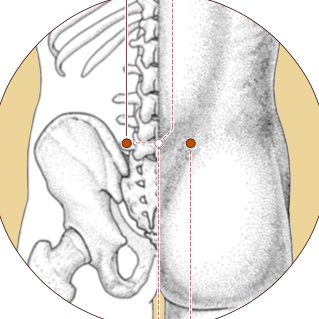
BL 25Located 1.5 cun lateral to the spine at the level of the junction of the 4th and 5th lumbar vertebrae, the point is tucked into the space above the sacrum and inside the ileum. Apply direct pressure. For treatment of lumber pain, press both BL 25 points and apply lateral pressure, thereby spreading the tissues of the low back. This treats the acu-points and releases the fascia of the region.


This is an extract from John’s forthcoming book on the Five Elements to be published by Jessica Kingsley Publishers www.jkp.com

We Are One

cupcakeYou will be forgiven for  thinking that this is a post about the non-dual nature of reality and the truth that we are all continually arising out of the same fabric of the universe. Another time perhaps. No, this is something far more mundane: a celebration of the first anniversary of this blog. And while you are enjoying the celebratory cup cake, here is a point to help you metabolise the sugars.

I introduced Spleen 3 in the previous posting as a good grounding point after air travel. Here we explore more deeply into this very balancing Earth point.


Transport Yourself

Years ago when industrial strike action was common, there was nothing more paralysing than a transportation strike. Planes grounded, trains halted, ports closed, trucks idle. The transport of people and goods is vital to the functioning of a country and its economy.

In the human body, the job of moving things around falls to the Spleen official. Of all the organs, the Spleen is the most unlike its western namesake. In fact it can be regarded more like a network than an organ like the Liver. Think of a subway map with its network of criss-crossing lines. Spleen is like the Minister for Transport who keeps things moving.

The main function of the Spleen is to assist the Stomach in the transformation of food essences and to transport these throughout the body. It is also responsible for the movements of Qi and fluids. When the Spleen Qi is strong there will be good appetite, digestion and elimination. When it is weak, there may be poor digestion, bloating and loose stools.

Another function of the Spleen is to control ascending Qi, partnering the Stomach’s role of controlling descending Qi. One way this operates is that the Spleen sends food Qi upwards to the Lung to support its function of gathering Qi from the breath. It also sends food Qi upwards to the Heart to assist in forming Blood. In an overall way, the Spleen provides support and upward lift to the body.

One interpretation of the pathway of the Spleen meridian is that it is like a crutch under the armpit, supporting an upright stance. When Spleen Qi is weak, there is often fatigue and sagging as if this upright support has been lost. The state of the Spleen is one of the most important factors in determining the amount of energy a person has.

When the functions of transformation, transportation and ascendance of Qi are operating well, then thinking is clear and the thoughts are settled. When the Spleen official is taking a sick day, then the mind can become fuzzy and muddled, worried by repetitive and obsessive thoughts.

Disorders of the Spleen are common and Spleen Qi deficiency is one of the most common patterns seen in clinical acupuncture practice in western countries. Causes of this include stress, lack of exercise, poor diet, eating too much sugar, eating cold food, eating irregularly and worrying about what you eat. Looking at this list, it is easy to see how this has become a western malaise.

One of the strongest points for tonifying and revitalising the Spleen is its source point, Taibai – Supreme White. As the Earth point on an Earth meridian, it is tremendously supportive of the Element and particularly effective between the hours of 9 am and 11 am when the Spleen Qi is at its highest level during the day.

It activates and strengthens the Qi of both Spleen and Stomach, thereby treating many digestive disorders including abdominal pain and fullness, intestinal gurgling (borborygmus), constipation, diarrhoea and haemorrhoids. By encouraging the Qi to ascend, Taibai also treats lethargy, fatigue and feelings of heaviness in the body, especially of the limbs. It also treats pain of the knees and thighs along the pathways of Stomach and Spleen.

Taibai is a good point for resolving damp. The Spleen is particularly susceptible to external damp, such as humid weather or wearing wet clothes. But internal damp often arises when the Spleen is not functioning well. Many of the symptoms of Spleen imbalance are a result of this dampness in the body.

The Spleen is also injured by ongoing obsessive thoughts and excessive worry. In these cases, Taibai helps to recharge the brain and the thinking processes. It brightens up your ideas! Similarly, when thinking is fuzzy and mental activity is fraught, this point clarifies thinking and improves memory. It brings groundedness, stability and a sense of coming back to centre.

So if you feel like your inner transport minister has gone on strike, hold Taibai and get him back to work.

Location of Spleen 3 – see previous posting