 A common problem of the spine is the bulging disc that occurs when the cushioning disc of connective tissue between two vertebrae bulges out, causing inflammation and putting pressure on the nerves that emanate from the spine. A more serious development is a herniated disc which sees a tearing of the outer layer of the disc. 95% of spinal disc herniation cases occur in the lower lumbar region at L4-L5 or L5-S1. Interestingly, the first of these positions is the location of a point on the Bladder meridian that relates to the Large Intestine.
Dachangshu – Large Intestine Shu can be of great benefit to those suffering from these disc protrusions and other painful conditions of the lumbar region. It is also useful in treating sciatica which originates in the lumbar region and radiates along the pathway of the sciatic nerve, through the buttocks, down the back of the leg and sometimes into the calf and foot.
As the shu point of the Large Intestine, Dachangshu exerts a strong influence over the organ as well as the functions of the official. When there is stagnation in the intestines, there can be a build up of waste material resulting in constipation, causing the abdomen to distend and bulge. This in turn creates abdominal discomfort and pain, and sometimes noisy gurgling of the intestines known as borborygmus.
On the other hand, the intestines may be loose, producing loose stools and diarrhoea. When waste moves too quickly through the Large Intestine, water and important minerals cannot be reclaimed and are lost. The Large Intestine shu point is helpful in treating conditions at both ends of this constipation – diarrhoea spectrum as well as treating rectal and anal prolapse.
The outer shu points are the points that treat the psycho-emotional dimension. As there is no outer shu point for the Large Intestine, this inner shu point can serve. Where a person is emotionally constipated, holding on to things, people, ideas or beliefs that are no longer of value, or even toxic, Dachangshu can assist in the process of letting go. Alternatively, when a person is unable to retain what is valuable and needed to live a healthy life, and lets go of or throws away things and people that are of value, this point is called for.
Location of Bladder 25
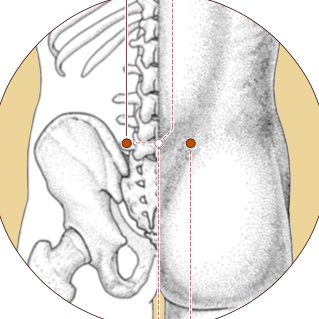 Located 1.5 cun lateral to the spine at the level of the junction of the 4th and 5th lumbar vertebrae, the point is tucked into the space above the sacrum and inside the ileum. Apply direct pressure. For treatment of lumber pain, press both BL 25 points and apply lateral pressure, thereby spreading the tissues of the low back. This treats the acu-points and releases the fascia of the region.
This is an extract from John’s forthcoming book on the Five Elements to be published by Jessica Kingsley Publishers www.jkp.com

