Last weekend I finished teaching a Level 1 Acupressure class which includes a highly effective neck and shoulder treatment. A point not included in that treatment is a point on the corner of the shoulder which students would do well to include when treating the shoulder.
Jianyu ~ Shoulder Bone ~ Large Intestine 15
 The scapula or shoulder blade is a bone that is attached to the rest of the skeleton by one small joint at the point of the shoulder. This is the acromioclavicular (AC) joint. Since this is the only place at which the scapula articulates with the skeleton, a great deal of stress can be placed on this joint.
Otherwise the scapula is held in place by the 17 muscles that attach to it, connecting it to the arm, chest, ribs, spine and neck in various ways. Given that we all have unique ways of holding and moving our upper body, the positioning of the scapula shows incredibly wide variations among people.
The acu-point that is very close to the AC joint is Jianyu – Shoulder Bone on the Large Intestine meridian. John Cross (2006) calls this the shoulder chakra, a minor chakra or energy vortex that influences the whole of the shoulder region. It is a powerful point for congestion in the shoulder, since most shoulder problems affect this place where the shoulder meets the arm.
Peter Deadman (2007) hails it as the preeminent point for treating the shoulder, for it treats paralysis of the arm, shoulder and hand, atrophy of the arm and upper body, arthritis and bursitis of the shoulder, and the chronic condition known as frozen shoulder. It benefits when there is an inability to raise the arm to the head, or to turn the head. Overall it promotes the circulation of Qi and blood throughout the upper arm.
What makes this such a potent point is that, like another important shoulder point SI 10, LI 15 is a meeting point with the Extraordinary Vessel Yang Qiao Mai (Yang Motility Vessel) whose trajectory includes the sides of the body from ankle to shoulder, as well as the neck, face and head. Because of this, Jianyu releases energy to the brain, provides mental clarity, and is good for mental exhaustion and headaches. It works well in conjunction with BL 62 which is the master point of the Yang Motility Vessel.
The point also treats windstroke and clears heat, thereby relieving skin rashes including hives (for which it is best combined with LI 4 and LI 11) and for treating toothache and hypertension. It can control sweating, including underarm perspiration. And it is available as a first aid point for concussion, shock and electric shock.
In short, Jianyu helps the shoulder to let go, which reminds us that letting go is one of the functions of the Large Intestine official. Most shoulder tension arises not simply from usage, but from solidified emotional patterns. We hold ourselves in ways that somatically replicate our inner state. Letting go in the shoulder involves letting go of the emotions, ideas and beliefs that dictate our posture and which are no longer of value in our lives.
Location of Large Intestine 15
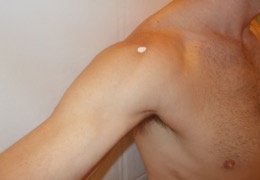
If you bend your elbow and raise your arm to shoulder height, two hollows appear at the point of the shoulder. LI 15 lies is the anterior (front) hollow. Once located, lower the arm and apply moderate, direct pressure.
This is an extract from my first book ‘The Way of the Five Elements’ which focuses on acupoints as a vehicle for healing. My second book ‘The Way of the Five Seasons’ explores many other ways we can heal through the Five Element model. Both books, published by Singing Dragon Press, are available now.
For signed copies at A$40 + postage, contact me directly.
Book Depository is a good place to buy online.